Business Solutions for Your Profitable Future
The Profit Improvement Process
Cost Reduction and Beyond
A Profit Improvement Process (PIP) engages the collective intellectual capital of the company to identify and harvest opportunities for profit improvement in all three areas of the profit equation: expense, loss, and revenue. This balance moves profit improvement far beyond traditional cost reduction efforts both in terms of profit results and the impact on personnel. People engaged in the Profit Improvement Process report better morale and improved attitudes as opposed to the negative impact often seen in cost reduction. The book Achieving World-Class Profit Improvement is the resource for this article.
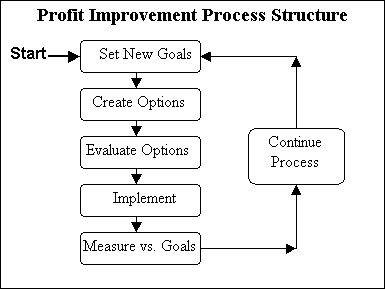
All employees are informed of the process and key employees are engaged in teams to enable change. Skill training includes the most advanced creativity and innovation tools available today. The training, process structure (figure below), annual goals, and continuous reporting create an environment that is conducive to positive change.
Figure 1 Profit Improvement Process Structure
A significant benefit of a PIP is the fact that all employees are aware of the cost-benefit of their investments and the profitability of their sales decisions. This focus on the profit equation keeps the company sharp and the employees in a learning mode. Employees learn that they are part of the profit solution rather than worrying constantly about what others are going to do to their jobs (i.e. layoffs and cutbacks).
Results are rapid and significant. In nine months one insurance company added over $5 million of sustainable profits to the bottom line with a two-year return in excess of 100 fold on its initial program investment. The backlog of potential profit improvement projects was in excess of $100 million after the first year. A $20 million revenue manufacturing and distribution company generated $1 million in profit improvement ideas in a few weeks. Within two years in a depressed market all of their profits could be attributed to the changes they made through profit improvement projects.
A key to success, beyond engaging the entire company in a positive way, is the use of the profit equation to balance growth and cutting. The price of forgetting the profit equation and not having a self-sustaining profit improvement process can be extreme. A July 9, 2001 article on the front page of The Wall Street Journal (Hilsenrath 2001) reports, “While the U.S. economy is showing tentative signs of stabilizing and could even stage a modest recovery by the winger, the corporate cost-cutting that started late last year could go on for quite some time.” The article also reports that Ron Nicole of the Boston Consulting Group, tracking the overhead costs of America’s 1,000 largest companies, found that many of them lost site of their revenue/cost ratios while building sales volume. He estimates that they are currently overspending by $150 billion per year. An executive vice president of International Paper said that the company has taken its first comprehensive, company-wide look at overhead costs since 1985. They found layers of costs that it didn’t need and opportunities for process improvement. They laid off 3% of their workforce in June and are 25 to 40% of the way done.
Cost Reduction in the absence of revenue consideration all too often leads to bad decisions that reduce profit in the near and long-term. PIP brings that needed balance.
Financial considerations
The cost of using consultants to initiate a profit improvement process is considerably less (a few percent) than that for massive programs such as TQM or Six Sigma. Training for implementation is one to two days depending on the level of involvement planned for the trainee. Companies, depending on size and complexity) usually choose to use consultants to train the core 10% of their staff and then bootstrap from there using internal trainers and peer training.
Consulting and training fees are variable depending on company size. They range from about ten thousand dollars for a small company with less than a hundred employees (train a dozen on more staff) to over one hundred thousand dollars for a company with a few thousand employees (train hundreds of staff).
The cash flow payback is usually a matter of a few months at most. Long term payback is as large as the profit goals allow.
Non-financial considerations
Like any change process, top management commitment is critical to success. It all starts at the top and it will end there if management is not clear in its support. While the process does help significantly in overcoming barriers to change, hypocrisy or inconsistency from the executive suite can kill potential faster than a speeding .
Even in this age of “employee empowerment” managers are often loath to cede any influence to the employees. Managers will find excuses not to train their people in profit improvement methods because they fear that they will lose control. They fear that some of their propensities and delinquencies will be exposed. They’re right. It takes motivation and confidence in the executive suite to engage in a Profit Improvement Process.
The Profit Improvement Process requires the following for success:
- Management support and commitment
- Adequate systemization as provided by the process
- Consistent reporting as provided by the process
- Delegation of authority to control expenses by people charged with responsibility
- Accountability for program compliance
- Use of appropriate project selection criteria as determined through the process
- Accommodation for change and growth
- A plan for the inevitable cycles of enthusiasm
- Use the change methods inherent to the process
- Focus on real profit changes not phony money
- Adequate training and communication as provided by the process
Summary
The Profit Improvement Process (PIP) incorporates the best of what has been used over the last century while avoiding the pitfalls. PIP is a synthesis of good business practice and the powerful tools of creativity and innovation methods embodied in Creative Problem Solving. This combination taps the intellectual capital of your employees to enable positive change. Profits flow from there. PIP incorporates change methods that help create the readiness for change that is critical to success .
Companies can undertake these initiatives on their own or they may engage expert consultants such as Business Solutions – The Positive Way to get them started. The essence of the process is embodied in the models and tools that are summarized in the book “Achieving World-Class Profit Improvement”. Companies that want to accelerate the process and maximize profit impact engage experts to get them started.
The flexibility of PIP allows the use of any of the tools associated with six-sigma and other quality programs without having to embrace the entire concept. Almost any productive tool or method is appropriate to the PIP continuous improvement model.
Ultimately there are only four approaches to cost reduction and profit improvement. Here is a summary.
Contact us today to start improving your company right away.